Uncategorized
A home inspection in Southwest Florida is about more than checking appliances and looking for a leaky faucet. Subtropical heat, humidity and salt air can accelerate wear on HVAC condensers and electrical components, even miles inland. Add a history of hurricane repairs and homes ranging from pre-1978 construction to brand-new builds, and the same inspection finding can mean something different here than it might elsewhere.
Use this as a list of things to investigate, not a diagnosis based on a home’s age. An inspector’s job is to report observable conditions; specialized testing and contractor estimates may be needed to understand the scope.
Start with the home’s age, but verify what’s actually there
Pre-1978 homes
Older homes may have features that deserve a closer look, including cast-iron drain lines and construction that predates modern hurricane standards. If cast iron is suspected, or there are slow drains, recurring backups or evidence of past patching, ask whether a sewer-camera scope makes sense. A standard inspection may not reveal the condition of pipe hidden beneath a slab.
For homes built before 1978, ask about lead-based paint disclosures and take appropriate precautions before renovation work. The home’s age alone does not prove that lead paint is present, but it does make the question relevant.
Mid-1960s to early-1970s homes
Some homes from this era may have single-strand aluminum branch wiring or older electrical panels, including Federal Pacific, Challenger or Zinsco models. These are not all the same issue, and a general inspection should not substitute for an electrician’s evaluation. But panel and wiring findings can affect safety, insurability and the work a buyer may need to budget for. Some insurers will not write a policy for homes with certain electrical components until they are addressed.

1980s and 1990s homes
Polybutylene plumbing can be a concern in homes from this period. The flexible pipe is often gray, but do not identify plumbing by color alone: have a qualified professional confirm the material and check for leaks, brittle fittings or prior partial repiping. Stucco cracks also deserve context. Some may be cosmetic, while others can signal movement or water entry; an inspector or qualified contractor can help determine whether further evaluation is needed.
Homes built before Florida’s first statewide building code took effect in 2002 may also have different construction details from newer homes. That does not make them automatically unsafe, but it makes documentation and a careful inspection especially useful.
2000s housing boom
For homes built or substantially remodeled in the early-to-mid 2000s, ask about any history of problem drywall, sometimes called “Chinese drywall.” Sulfur or rotten-egg odors, unusual corrosion on copper wiring or HVAC components, and repeated equipment problems may warrant further investigation. Those signs are not proof of problem drywall; a qualified specialist may be needed to assess or test a suspected case.
Workmanship also varied during the building boom. Pay attention to signs of poor installation, incomplete repairs or water intrusion, rather than assuming that a newer build is problem-free.
2002 and newer, including new construction
Newer building codes offer important advances, but age and code era do not tell you the home’s current condition. Verify permits for roof replacements and other major work, review the home’s protection features, and assess the HVAC system. Even newly built homes can benefit from an independent inspection: flashing or drainage errors, settlement cracking, HVAC sizing issues and unfinished punch-list items may be easier to address before closing.
Add inspections that match the property
A general home inspection is only one part of due diligence. Depending on the home, consider these additional reviews:
- Four-point inspection: Focuses on the roof, electrical, plumbing and HVAC systems. Insurers often require one for older homes. It is an insurance-oriented report, not a replacement for a full buyer’s inspection.
- Wind-mitigation report: Documents features such as roof connections and opening protection. Read the report to understand what features are present; it is not a certificate that the home has no defects. Florida’s Department of Financial Services explains wind-mitigation inspections and forms. Roof age and documentation can matter to insurance, but confirm specific requirements with the insurer.
- WDO/termite inspection: Ask about signs of subterranean or drywood termites, including damaged wood, frass (termite droppings) and discarded wings. If there is a termite bond, find out whether it can transfer and what it covers.
- Mold or moisture assessment: Consider a specialist if a property has been closed up for a long time or shows signs of persistent moisture. A licensed mold assessor is a separate professional; a standard inspector’s visual review is not the same as a mold assessment.
- Sewer-camera scope: Worth discussing for older drain systems, suspected cast iron, recurring backups or other warning signs.
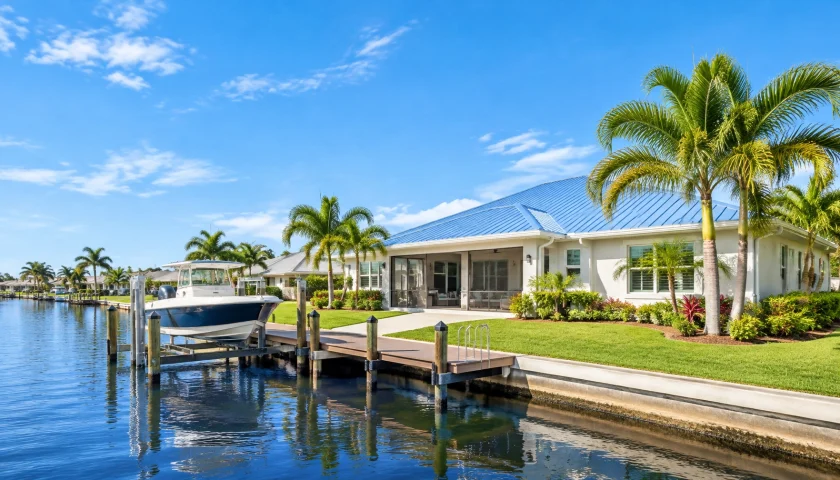
- Seawall, dock and boat-lift inspection: For canal-front homes, hire a waterfront specialist rather than relying on a general inspection. Look for soil depressions behind the wall, cap cracks, bowing, possible tie-rod corrosion, piling condition and lift electrical compliance. Repairs may require permits or coordination with agencies such as the Florida Department of Environmental Protection or the U.S. Army Corps of Engineers.

Check permits, especially after hurricane repairs
For a Cape Coral home, use the City of Cape Coral’s online permit search to look for records on additions, pool enclosures, roof replacements and marine work. Buyers looking elsewhere should check the relevant city or county portal.
A missing or incomplete permit record does not, by itself, tell you exactly what happened. But unpermitted work can create costly questions about code compliance, required retrofits, insurance or future resale. For repairs made after Hurricane Ian, ask what was repaired, who completed the work and whether permits were obtained when required.
If you are hiring a licensed professional, you can check credentials through Florida’s DBPR license lookup.
What a finding means for your decision
An inspection report is not automatically a seller repair list. Under the Florida As-Is Residential Contract, the inspection period is generally the buyer’s decision window to investigate and decide how to proceed under the contract’s terms. Read your specific contract and note the deadline; if you need legal advice, consult a Florida real estate attorney.
Sellers may prefer offering a credit over arranging repairs. But a major issue with one of the four-point systems (roof, electrical, plumbing or HVAC) can become more than a negotiating point if an insurer will not cover the home or a lender will not fund the purchase without a required repair or acceptable policy. Confirm those requirements promptly with your insurance agent and lender.
When a report flags a significant issue, get contractor estimates quickly, while there is still time to make an informed decision. Separate:
- Safety, structural or insurability concerns that may call for specialist review or a repair plan.
- Maintenance and cosmetic items that are real but may not justify derailing a purchase.
This distinction helps prevent inspection fatigue: a long report can include many observations, but not every item has the same urgency or consequence.
Budget for the right scope
As a regional ballpark, a standard inspection for a typical single-family home may run roughly $375–$675, depending on the property and scope. Published local inspection-industry schedules vary, and larger homes can cost more. Four-point and wind-mitigation reports may be available as lower-cost add-ons when bundled, but ask what is included. A seawall or mold inspection requires a separate specialist and separate pricing.
These are estimates, not fixed or regulated rates. Compare written scopes, exclusions and turnaround times, and check the qualifications of the person you hire.
The takeaway: investigate the house you’re buying
An older home is not automatically a bad home, and a new home is not automatically a safe one. The useful question is: What am I actually buying, and what will it take to insure, maintain and enjoy it?
The right inspection plan depends on the home’s age, systems and location. A local agent can help you identify which inspectors and add-ons may fit the property and keep the inspection-period timeline in view. RE/MAX Realty Team has more than 100 agents, two offices and a record as the region’s #1 producing brokerage for more than 14 years. Connect with Cape Coral real estate agents and visit swflhomestoday.com to start planning your Southwest Florida move.