Uncategorized
A flood map may look like a technical document, but a changed flood-zone designation can affect a home’s insurance costs, a lender’s requirements, and the way a buyer evaluates an offer. For Southwest Florida buyers and owners, Lee County’s upcoming FEMA map revision is a reason to check the details, not assume every address will be affected.
The revised Flood Insurance Rate Map (FIRM) for certain unincorporated areas of Lee County takes effect March 2, 2027. It is a limited revision, not a countywide remapping. That distinction matters, especially around city boundaries and for buyers comparing nearby homes.
1. What changes on March 2, 2027-and who is affected?
Lee County says the revision affects six map panels in unincorporated Lee County. It does not apply within the City of Cape Coral, whose current FIRM has been effective since November 17, 2022. That means a Cape Coral property and a property just beyond the city limit could be subject to different map cycles. Sanibel, Fort Myers Beach, and other incorporated jurisdictions may also have their own applicable map information.
Check the Lee County map revision page for the affected panels and updates. For a specific address, use the FEMA Map Service Center and confirm the result with the relevant local floodplain office. A map viewer is a useful starting point, but a lender’s formal flood determination may be what governs a loan requirement.
Zone letters are part of the conversation. AE generally indicates a mapped high-risk flood area where base-flood elevations are provided. X usually indicates a lower-risk area; X500, often shown as shaded Zone X, indicates moderate risk. These labels are not guarantees that a property will, or will not, flood.

2. How a zone change can affect your payment and offer
If a property is mapped in a Special Flood Hazard Area, flood insurance is generally required for a federally regulated or federally backed mortgage. A new designation can therefore affect whether a lender requires coverage, what coverage a buyer needs to budget for, or how the lender evaluates the property. A lender may also require coverage outside a high-risk zone, so confirm the requirement directly.
For a simple sense of scale, an annual premium of $1,800 is equivalent to about $150 a month; $6,500 is about $542 a month. A $400–$1,500 annual premium works out to roughly $33–$125 a month. These are illustrative monthly equivalents, not monthly bills or quotes, and they don’t include homeowners insurance, taxes, or other ownership costs.
That difference can change a buyer’s comfortable price range. Before removing contingencies, get a flood quote for the actual address and share it with your lender. If the quote or lender requirement differs from what you expected, discuss options and the property’s total monthly cost before finalizing your offer.
3. Flood insurance math in 2026: quotes, elevation, and private coverage
Under FEMA’s Risk Rating 2.0, NFIP pricing is property-specific, not based on ZIP code alone. Building characteristics, location, flood risk, replacement cost, and other factors contribute to the rate. FEMA’s Risk Rating 2.0 overview explains why two nearby homes can receive different premiums.
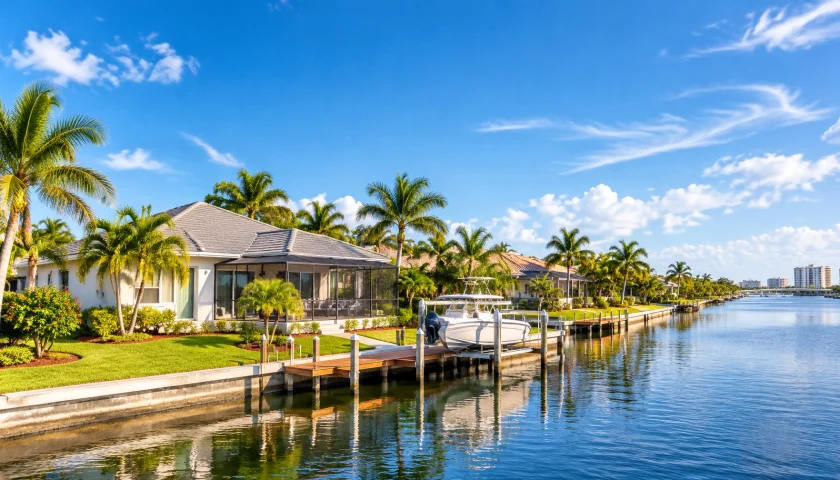
As a rough local planning range, not an insurance quote, canal-front homes in AE zones may run about $1,800–$6,500 per year, while inland X-zone properties may fall around $400–$1,500. Actual costs can land outside these ranges. A property-specific estimate should account for coverage limits, deductibles, building details, claims history, and the insurer’s underwriting.
An elevation certificate documents elevation information for a structure. Under Risk Rating 2.0, it is generally not required to rate every NFIP policy, but FEMA says owners can provide available elevation information to their insurance agent. It is one of the most useful documents to investigate when exploring a premium: it may help refine a quote, but it does not guarantee a lower rate.
Private flood insurance is another option. Some eligible properties may qualify for coverage priced 30%–60% below NFIP, and some private policies can offer dwelling limits above the NFIP’s $250,000 limit. Neither price nor coverage is guaranteed. Compare the policy limits, deductibles, exclusions, replacement-cost terms, and lender acceptance before choosing.
4. Seawalls: the canal-front cost that can surface late
On a private residential lot in Cape Coral, the homeowner is generally responsible for the seawall and its upkeep; there is no city-funded program for private seawalls. A wall can appear sound above water while anchors or soil behind it are failing. A marine inspection is the reliable way to assess condition.
Indicative local cost ranges can vary widely: smaller repairs (such as crack injection, cap patching, or tieback work) may run around $100–$400 per linear foot. Full replacement may cost $400–$1,300 or more per linear foot. On a typical 80–100-foot lot, that can mean roughly $50,000–$130,000 for replacement, depending on the property and scope. Replacement can trigger current city engineering standards. Obtain an itemized estimate from a qualified contractor; treat these figures as planning ranges, not bids.
For buyers, ask for seawall permits, past repair records, and a recent inspection, or make inspection part of due diligence. For sellers, arranging an inspection before listing can help identify work early and reduce last-minute surprises.

5. Florida’s flood disclosure, and what it does not cover
Under Florida Statute § 689.302, a seller of residential property must provide the statutory flood disclosure to the buyer at or before execution of the sales contract. It asks about the seller’s knowledge of flooding that caused damage during ownership, flood-damage insurance claims, and flood-related assistance.
The form concerns flood history and claims; it does not require disclosure of seawall condition. That is not permission to withhold a known material defect: sellers still have a common-law duty to disclose known material defects that are not readily observable. The flood form also does not replace inspections, insurance research, or review of seawall records.
Sellers can prepare now by gathering the completed flood disclosure, elevation certificate, permits, repair invoices, insurance-claim information, and records of elevation work or substantial improvements. Keep seawall documents with the packet, even though the statutory form does not cover its condition.
6. A practical due-diligence checklist
Whether you’re buying a home, listing one, or reviewing a waterfront investment, take these steps:
- Verify the map zone. Check the address through the Lee County flood map resources or FEMA Map Service Center. Confirm which jurisdiction and map cycle apply.
- Request an existing elevation certificate. If none is available, ask your insurance agent or a qualified surveyor whether ordering one makes sense for the structure.
- Get property-specific flood quotes. Compare NFIP and private options with the same coverage limits and deductibles before removing contingencies.
- Ask the lender early. Confirm whether flood coverage is required and whether the lender accepts the policy you are considering.
- Order a marine inspection for canal-front property. Request the seawall history, permits, and repair records; budget for a specialist’s findings.
- Document seller information. Compile flood history, claims and assistance records, permits, repairs, and elevation work for the disclosure and seller packet.

7. Local context, and the bottom line
Flood and waterfront diligence is one part of a changing local market. The latest regional snapshot puts active inventory near 15,300, about 8% above September but still roughly 19% below January 2026. Lee County has about 5.3 months of supply. September median prices were near $367,000 in Cape Coral and $340,000 in Fort Myers. Thirty-year fixed mortgage rates have been around 7.4%, depending on the reporting date and loan assumptions.
Two local developments are also worth watching: Lee County approved a $5 million purchase of roughly 306 acres near the Caloosahatchee River between Punta Rassa and Shell Point, resolving a development lawsuit and preserving the land. And the proposed Fort Myers Beach/Iona-McGregor fire district merger is on the November 3, 2026 ballot; it requires approval by voters in both communities.
Bottom line: Buyers should verify the map, get a real insurance quote, and inspect the seawall before committing. Sellers should assemble flood, elevation, permit, and repair records early. Investors should include insurance and waterfront maintenance in the operating budget, not just the purchase price. Market, insurance, and repair figures above are averages or illustrative ranges, not property-specific quotes, bids, or valuations.
For local guidance on buying, selling, renting, or investing in Cape Coral, Fort Myers, Sanibel, Fort Myers Beach, and nearby communities, contact RE/MAX Realty Team at 239-242-2000.