Uncategorized
If you are watching the Cape Coral market update 2026 headlines, you may be wondering where your money has the best opportunity right now: a waterfront home with boating access or an inland property with a lower purchase price and potentially simpler ownership costs.
The answer depends on your goals. Waterfront continues to command a meaningful premium in Cape Coral and Fort Myers, particularly for Gulf-access, sailboat-access, riverfront, and Gulf-front homes. At the same time, inland properties may offer a lower barrier to entry, more predictable expenses, and a broader pool of potential buyers or renters.
Late September 2026 is giving buyers more breathing room than they had during the 2021–2022 frenzy. Inventory is elevated, marketing times are longer, and negotiations are more common. However, the market is not uniform. Waterfront and inland homes are behaving differently, and the details behind the price tag matter.
The late-September 2026 market at a glance
Here is the broader picture across Lee County and the Cape Coral–Fort Myers metro:
- Fort Myers median sale price: Approximately $334,818, down about 6% year over year
- Fort Myers median days on market: Approximately 74 days
- Fort Myers months of supply: Approximately 4.4 months
- Cape Coral August median price: Approximately $382,375
- Cape Coral months of supply: Approximately 4.8 months
- Cape Coral–Fort Myers metro median list price: Approximately $425,000
- Metro median days on market: Approximately 112 days as of late September
These numbers point to a market moving toward more balanced conditions. Buyers have more choices and negotiating leverage than they did several years ago, while sellers must pay closer attention to pricing, presentation, condition, and market positioning.
Citywide statistics, however, blend together very different properties. A modest inland home, a freshwater canal property, a Gulf-access home, and a riverfront estate should not be evaluated using the same expectations.
Waterfront still earns a premium, but not every waterfront property is equal
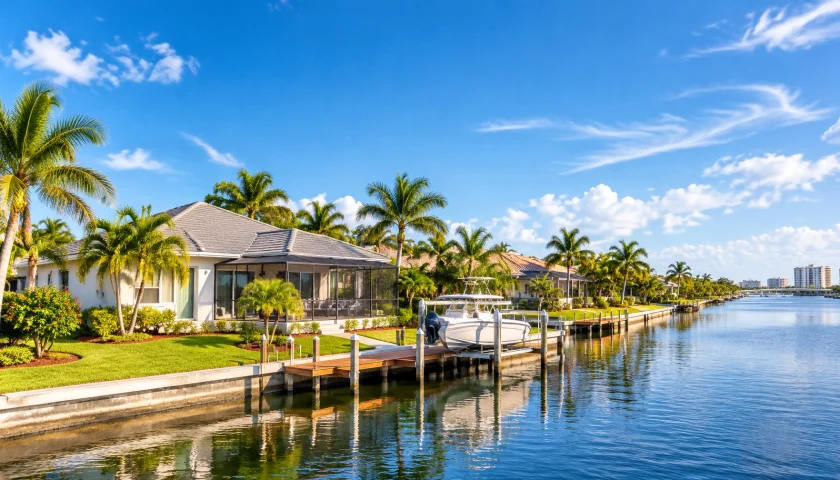
In Cape Coral, “waterfront” can mean several different things. A freshwater canal home may offer attractive views and kayaking access but no route to the Gulf. A Gulf-access home may connect to open water through bridges, while a sailboat-access property offers fewer height restrictions. Riverfront and Gulf-front homes occupy an even more limited and premium segment.
Typical pricing tiers in the current market broadly look like this:
- Inland or off-water homes: Often in the upper-$200,000s to low-$300,000s, depending on condition, age, location, and size
- Freshwater canal homes: Commonly in the mid-$400,000s and above
- Bridge-restricted Gulf-access homes: Often around $600,000 to $650,000 and higher
- Sailboat-access homes: Frequently $700,000 to $755,000 and above
- Premium riverfront, wide-basin, or extensively upgraded properties: Often $1 million or more
Recent Cape Coral analyses have shown a waterfront-to-off-water median price gap of roughly $270,000, although the exact premium varies by neighborhood, canal width, boating access, home condition, and improvements.

The important takeaway is that buyers are not simply paying for a view. They are paying for access, scarcity, lifestyle utility, and the potential to use the property as a primary residence, second home, seasonal retreat, or vacation rental.
In Fort Myers, waterfront pricing is more varied. Riverfront properties along the Caloosahatchee, homes near McGregor Boulevard, canal communities, and waterfront condominiums each have distinct buyer pools. Some riverfront and luxury properties can reach well above the citywide median, while inland neighborhoods may remain closer to the broader Fort Myers price range.
Inland homes may offer more predictable ownership costs
Inland properties generally cost less to purchase than comparable waterfront homes. That lower price can create several advantages:
- More accessible monthly payments: A lower purchase price may reduce the amount needed for a down payment and financing.
- Broader resale audience: Inland homes may appeal to first-time buyers, local families, retirees, and investors seeking a lower acquisition cost.
- Potentially simpler insurance planning: Inland homes are not automatically low-risk, but they may be less likely to carry the combination of flood, wind, seawall, dock, and coastal exposure concerns associated with waterfront properties.
- More flexibility in renovations: Buyers may have more room in their budget for updates, energy improvements, or rental-ready improvements after closing.
That does not mean inland is always the better investment. A well-located waterfront property can retain strong appeal because supply is limited and many buyers specifically want boating access or water views. But inland buyers may be able to achieve stronger cash-flow prospects, or at least lower carrying costs, depending on the property, financing, rental restrictions, taxes, insurance, and management expenses.

The four deal-shapers every waterfront buyer must investigate
The waterfront premium only works when the underlying property supports it. Before making an offer, buyers should evaluate four major issues.
1. Insurance
Insurance costs remain one of the biggest differences between waterfront and inland ownership in Southwest Florida. Wind coverage, flood coverage, deductibles, roof age, construction type, mitigation features, and prior claims can all affect the final cost.
Do not rely on a seller’s current premium as a guarantee. Request fresh quotes for the exact property and your intended coverage before the inspection or financing deadlines expire.
2. Flood zone designation
A home’s location near water does not tell the entire story, and being inland does not mean a property has no flood risk. FEMA explains that flood maps indicate the likelihood of flooding and help lenders determine insurance requirements.
Use the official FEMA Flood Map Service Center to review the property’s current mapping information. Flood zones can change, and the exact parcel, not just the neighborhood, matters.
3. Seawall and dock condition
A seawall is part of the waterfront property’s value and its future maintenance obligations. Cracking, bowing, erosion, settlement, or deterioration behind the wall can signal a significant repair or replacement expense.
Buyers should ask about:
- The age and condition of the seawall
- Recent inspections or engineering reports
- Dock and lift permits
- Shoreline erosion
- Canal width and navigability
- Bridge clearance and route to open water
A seawall issue may not be obvious during a standard home inspection, so specialized waterfront due diligence is often worthwhile.
4. Roof age and storm resilience
Roof age can affect both insurability and negotiating leverage. Buyers should review permits, inspection reports, wind mitigation features, roof materials, and evidence of storm damage or repairs.
A newer roof, impact-rated openings, elevation improvements, and documented maintenance may help support value. An older roof or incomplete repair history can make a seemingly attractive waterfront price less appealing after insurance and replacement costs are calculated.
What this means for buyers
Buyers have more leverage in late September 2026, but the best opportunities are not always the properties with the biggest price reductions.
For inland homes, focus on condition, location, resale appeal, and total monthly cost. A properly priced home with updated systems and reasonable insurance may offer better value than a cheaper property requiring immediate repairs.
For waterfront homes, negotiate based on the complete property, not just the list price. A seller may be more flexible on price, closing costs, repairs, seawall work, dock equipment, or insurance-related concerns. Compare the home’s boating access and physical condition with recent sales in the same waterfront category.
Working with experienced Cape Coral real estate agents or realtors in Cape Coral is especially important when evaluating canal access, flood mapping, seawall responsibility, and local resale patterns.
What this means for sellers
Waterfront sellers should not assume that a premium location eliminates the need for accurate pricing. Higher inventory means buyers can compare your property with more alternatives, including newer construction and homes with updated roofs, seawalls, kitchens, and insurance documentation.
A strong waterfront marketing strategy should clearly explain:
- Type and quality of water access
- Bridge restrictions and boating route
- Seawall and dock history
- Roof age and permits
- Flood zone information
- Recent updates and storm mitigation features
- Insurance considerations, where appropriate
Inland sellers also need a realistic strategy. Buyers are comparing monthly payments and total ownership costs carefully, so a clean, well-maintained, correctly priced home can stand out even in a slower market.
What this means for investors
Investors should separate lifestyle value from financial performance. Waterfront homes may attract seasonal renters and vacation-home buyers, but they also tend to involve higher acquisition costs, insurance expenses, maintenance obligations, and specialized repairs.
Before purchasing, analyze:
- Long-term versus seasonal rental demand
- Local rental regulations and HOA restrictions
- Insurance and flood premiums
- Property management fees
- Pool, dock, lift, and seawall maintenance
- Vacancy assumptions
- Resale liquidity at your target price point
An inland property may produce a more manageable investment profile, while a waterfront property may offer stronger lifestyle appeal and scarcity value. Neither category is automatically superior.
Local guidance makes the difference
Real estate decisions in Cape Coral and Fort Myers require more than a broad market statistic. The right evaluation depends on the neighborhood, property type, canal category, flood designation, construction age, insurance profile, and intended use.
RE/MAX Realty Team brings more than 100 full-time real estate professionals, two Southwest Florida offices, and deep Lee County market knowledge to buyers, sellers, renters, and investors. The brokerage has also been the region’s #1 producing brokerage for more than 14 years.
Whether you are comparing available SWFL properties, preparing to sell, or evaluating a waterfront investment, local guidance can help you compare the full cost and potential of each opportunity.
The takeaway
Waterfront property in Cape Coral and Fort Myers still commands a premium, especially when it offers Gulf, sailboat, river, or direct boating access. Those properties can move faster than comparable inland homes when they are correctly priced and well maintained, but their purchase price is only one part of the decision.
Inland homes may offer a lower entry point, broader resale appeal, and more predictable ownership costs. Waterfront homes may offer scarcity, lifestyle value, and stronger emotional appeal, but they require careful review of insurance, flood zones, seawalls, docks, and roofs.
In the more balanced late-September 2026 market, the smartest purchase is not necessarily waterfront or inland. It is the property whose price, condition, carrying costs, and long-term purpose work together.