

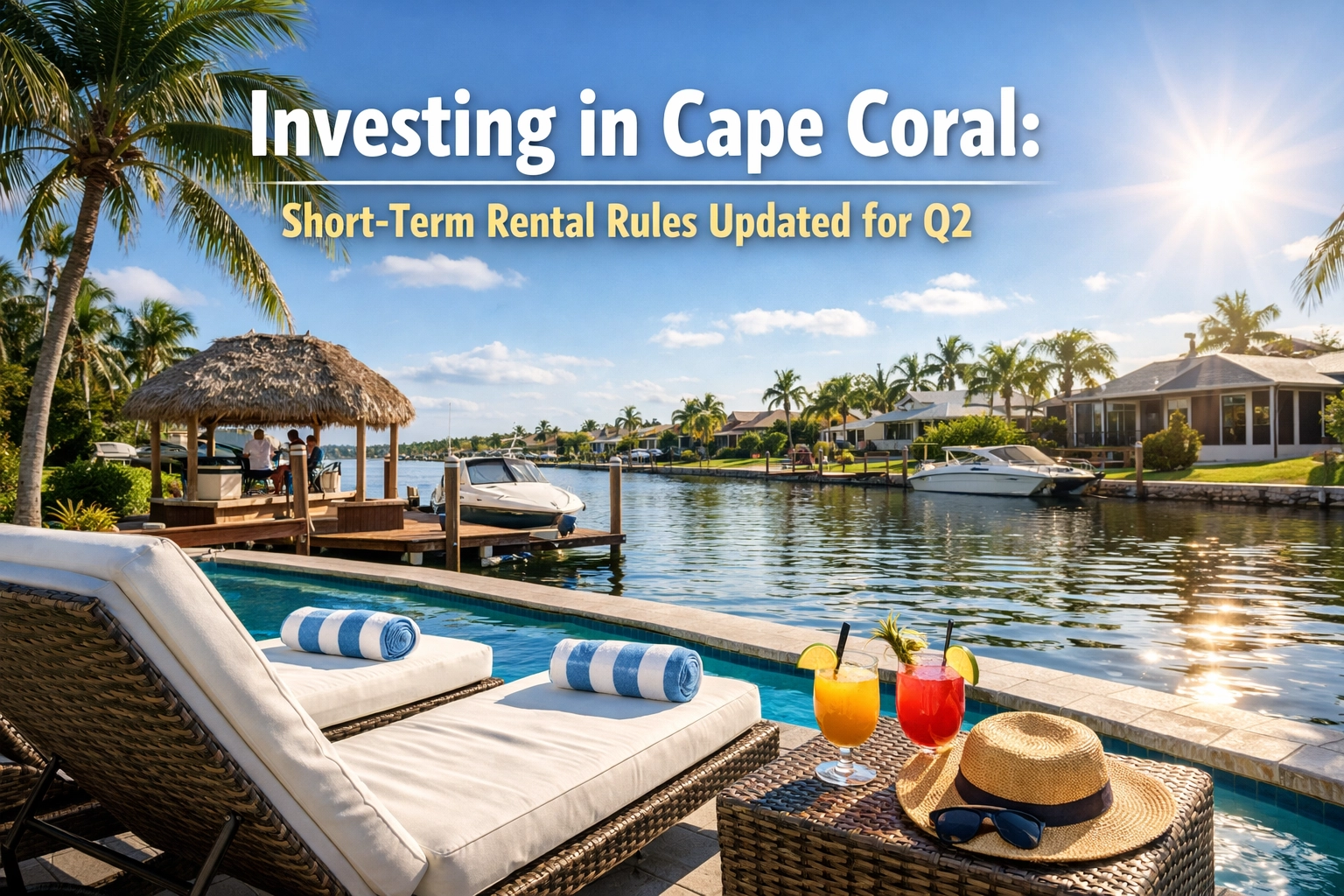
If you have been keeping an eye on the Cape Coral real estate market lately, you know it is one of the hottest spots in Southwest Florida for vacation rentals. With our hundreds of miles of canals and that year-round sunshine, it’s a magnet for travelers. But if you’re planning to jump into the short-term rental (STR) game or you already have a portfolio here, pull up a chair.
As of the second quarter of 2026, the landscape has shifted. The City of Cape Coral has officially moved past the "grace period" of the new regulations that kicked in at the start of the year. We are seeing more oversight, higher fees, and a much more structured approach to how these properties are managed.
Don’t let that scare you off, though. Increased regulation often means a more professional, stable market, which is actually great news for serious investors. Let's break down exactly what you need to know to stay compliant and profitable this year.
The Big Shift: Registration and the $350 Question
For years, registering a rental in Cape Coral was almost an afterthought. You paid a one-time fee of $35, and you were basically set. Those days are gone.
Since January 1, 2026, the city has implemented an annual registration requirement. The fee has jumped from that nominal $35 to $350 per property, every single year. While that might feel like a bit of a sting, the city is using these funds to beef up the department that handles rental oversight and neighborhood harmony.
Here’s the deal: If you are leasing your property for six months or less, you fall under the STR category. You have to register through the city's online portal. If you own multiple properties under the same exact ownership name, there are some options to bundle them, but for most "mom and pop" investors with a single-family home or two, expect to budget that $350 as a standard annual operating cost.

Don't Forget the State Requirements
While the city’s $350 fee is the big headline, you can’t forget about the State of Florida. To legally operate a short-term rental here, you also need a state lodging license. Luckily, this one is much cheaper: usually around $50: but it is a non-negotiable step.
You’ll also need to register for a state tax certificate. Between the city and the state, the paperwork can feel a bit overwhelming at first, but once you’re in the system, the renewals are generally straightforward. If you’re looking for a hand navigating which properties are currently the best "turn-key" options that already have these licenses in place, check out what’s available at http://www.swflhomestoday.com.
The 15-Day Rule
One thing many owners are tripping over in Q2 is the reporting requirement. If you change property managers, update your contact information, or even change the designated "24/7 emergency contact" for the property, you have to notify the city within 15 days.
The city wants to know exactly who to call if a neighbor reports a noise complaint or if there’s a trash issue. If they call the number on file and it’s disconnected or belongs to a manager you fired three months ago, you’re looking at an immediate red flag for code enforcement.
Enforcement is No Longer "Suggestions"
In the past, Cape Coral was somewhat relaxed about STR enforcement unless someone really made a mess of things. That is no longer the case. The city is actively monitoring rental platforms and cross-referencing them with their registration database.
The penalty structure is now very clear: and it can get expensive fast:
- First Violation: $500 fine.
- Repeat Offenses: $1,000 per violation.
And here is the kicker: the city can treat each day a violation continues as a separate offense. We saw a case last year where an owner ended up with over $30,000 in fines because they ignored the rules and kept booking guests without the proper registration. In Q2 2026, the city is even more organized. They have the staff and the software to track this, so trying to "fly under the radar" is a high-risk, low-reward strategy.

Taxes: Lee County Wants Their Cut
We can’t talk about rental income without talking about the "bed tax." In addition to your standard state taxes, STR operators in Cape Coral must collect and remit the Lee County Tourist Development Tax.
This is a tax charged to your guests, not a tax on your personal income, so it shouldn't affect your bottom line: provided you set up your booking platform (Airbnb, VRBO, or your own site) to collect it correctly. Most of the big platforms handle this automatically, but you are still legally responsible for ensuring it’s being paid. If you’re managing the bookings yourself, you’ll need to register with the Lee County Tax Collector’s office.
Investment Trends: Is Cape Coral Still a Buy?
With higher fees and stricter rules, you might be wondering: Is it still worth investing in Cape Coral rentals in 2026?
The short answer? Yes. But you have to be smarter about it.
In Q2 2026, we are seeing a "flight to quality." Because the barrier to entry is slightly higher (both in terms of cost and administrative effort), the casual, "unprofessional" hosts are starting to exit the market. This leaves more room for serious investors who provide a high-quality experience.
What’s working right now:
- Waterfront is King: Properties on the water, especially those with Gulf access, continue to see the highest occupancy rates. Boaters are willing to pay a premium that easily covers the new registration fees.
- Pet-Friendly Rentals: There is a massive shortage of high-quality, pet-friendly STRs in SWFL. Owners who allow dogs (and have a fenced yard) are seeing significantly fewer vacancies.
- Modern Amenities: High-speed internet (for the "work from Florida" crowd), heated pools, and outdoor kitchens are no longer "bonuses": they are expectations.

The Neighborhood Factor
One of the reasons the city updated these rules was to protect the "residential character" of our neighborhoods. As a smart investor, you want your neighbors to like you (or at least not notice your guests).
We are seeing more investors opt for the Southwest and Southeast quadrants of the Cape, where the rental market is more established. However, the North Cape is growing rapidly. If you’re looking for a newer build with potentially lower maintenance costs, the North is great, but just be aware that the canal systems there can be more complex (and sometimes have bridges that limit boat size).
If you're trying to figure out which quadrant fits your investment goals, feel free to browse the latest neighborhood listings at http://www.swflhomestoday.com.
Managing the Q2 2026 Market
If you are buying a property this quarter, make sure your due diligence includes a "rental compliance" check. Check if the home has any outstanding code enforcement liens. Ask for the previous owner’s registration history if they were using it as an STR.
Also, consider your management strategy. With the 15-day update rule and the 24/7 contact requirement, "self-managing" from a thousand miles away is becoming much harder. Many owners are turning to local property management teams (like us!) to ensure they never miss a deadline or a city notification.

Summary and Key Takeaways
The "Wild West" days of Cape Coral short-term rentals are officially over, but the new era is one of professional, high-standard hospitality. Here’s your Q2 2026 cheat sheet:
- Annual Registration: It’s now $350 per year. Mark your calendar so you don't hit late fees.
- The 6-Month Mark: Anything leased for 6 months or less is an STR.
- Compliance is Mandatory: Fines start at $500 and can escalate to $1,000+ per day. It’s not worth the risk.
- Stay Local: Ensure you have a 24/7 contact on file who can actually show up to the property if there’s an issue.
- Quality Wins: The market is rewarding investors who put in the effort to maintain a top-tier property.
Cape Coral remains one of the best places in the country to own a vacation home. The canal system is unique, the weather is unbeatable, and the demand from travelers isn't slowing down. By staying on top of these new rules, you're protecting your investment and ensuring your guests have a great experience.
If you have questions about a specific property or want to know more about the best investment zones in the Cape right now, don't hesitate to reach out. We live and breathe this market every day!