Uncategorized
Cape Coral can look like a straightforward choice: sunny weather, plenty of homes, and canals woven through the city. But day-to-day life here, and the cost of owning a home, depends on more than the listing price. Utility service, insurance, how you get around, and even how school assignments work can vary from one address to the next.
Here’s a practical 2026 overview to help you budget and decide what to ask before choosing a home.
Start with the home price, and look beyond it
A useful planning range for a typical Cape Coral home in 2026 is roughly $370,000 to $400,000. Recent market figures differ depending on the time period and type of home counted, so treat that range as a starting point, not a promise about what a particular property should cost. Waterfront access, age, condition, location, and lot characteristics all influence price. For a snapshot of changing prices and activity, see this Cape Coral market update.
The monthly mortgage payment is only one part of the budget. Homeowners insurance, possible flood insurance, property taxes, utility assessments, HOA fees, and ongoing maintenance can make two similarly priced homes cost very different amounts to own.
Ask for the property’s current tax bill and review every assessment listed on it. Cape Coral may also charge recurring municipal assessments, including for fire services, solid waste, and stormwater. Those costs are separate from ordinary property taxes and can vary by parcel.
Insurance deserves an address-specific quote
Homeowners insurance and flood insurance are not the same thing. A standard homeowners policy does not cover flood damage, and a home’s flood zone, elevation, construction, age, roof, claims history, and coverage limits can affect what insurers will charge.
Don’t assume a home in a lower-risk zone has no flood exposure. The City notes that properties outside Special Flood Hazard Areas can still flood. Cape Coral participates in FEMA’s Community Rating System, which provides qualifying properties with a flood-insurance discount; the city reports discounts of 25% in A, AE, and V zones and 10% in X zones.
Before your inspection period ends, get written insurance quotes for the specific address. You can check a property’s flood information through the city’s Forerunner flood-risk portal and review the city’s flood protection resources. A flood-zone lookup is a helpful first step, not a substitute for an insurance quote.
Utilities: check what the home actually has
Cape Coral homes may have city water, wastewater, and irrigation service, or rely on well and septic systems, particularly in some northern areas. Don’t assume that a home is connected to city utilities because it has a Cape Coral address. Ask what services are currently available, what the home uses today, and whether any connection work or future charges apply.
Utility bills also depend on usage and the rates in effect. The city’s rate schedule effective October 1, 2026 lists monthly base charges for standard residential water and wastewater meters, as well as usage charges. Irrigation is billed separately. Check the current city utility rates, then request recent bills from the seller to understand the home’s real pattern of use.
Understand UEP assessments before making an offer
Some areas are part of a Utilities Extension Project, or UEP, that brings city water, sewer, and irrigation infrastructure to properties. The cost can be a major ownership expense. For example, the city lists North 1 West land-area assessments totaling $26,617 per 10,000-square-foot equivalent parcel. A separate capital facility expansion charge for a typical 5/8-inch meter receiving all three utilities is $6,750. Actual amounts depend on the parcel and project details.
These charges may be paid or financed in different ways, so ask for the parcel’s current UEP status: what has been paid, what balance remains, and whether the amount appears as an installment on the tax bill. The city’s North 1 West assessment page explains how that project’s charges are calculated. Don’t rely on a general neighborhood estimate; confirm the numbers for the exact property.

Waterfront comes in different flavors, and with upkeep
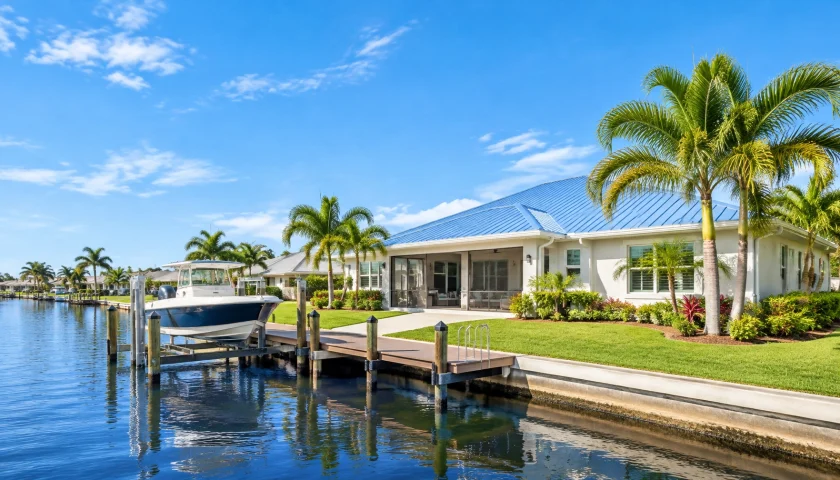
A canal view does not automatically mean boat access to the Gulf. Cape Coral has Gulf-access canals as well as freshwater canals. Gulf-access homes may offer boating routes toward open water, while freshwater canals are not connected to the Gulf in the same way. That distinction can affect price, insurance considerations, and how you plan to use the property.
Waterfront buyers should also take the seawall seriously. Its condition can become a substantial future expense, even when the house itself appears move-in ready. Have a qualified professional evaluate the seawall and ask about its age, repairs, permits, and any available documentation. Include seawall condition in your decision, not just the canal view.
Expect a car-centered routine
Cape Coral is spread out, and most residents rely on a car for errands, appointments, school drop-offs, and commuting. There isn’t a compact, walkable downtown core that serves the whole city. The Southeast offers comparatively convenient access to the bridges and central activities; the Southwest includes gated and higher-end communities; and the North has many newer homes, along with areas where city utility service may differ.
Those are broad orientation points, not strict neighborhood rules. Drive the routes you expect to use at the times you’ll use them. Check the distance to work, groceries, medical care, schools, and the bridges, not just the number of miles on a map.

School placement is not simply based on your street
Families moving from places with neighborhood-based school assignments should know that Lee County uses an open-enrollment and school-choice process for many students. Families submit ranked choices, and applications are processed through an assignment lottery. For the 2026–27 cycle, the district said applications were processed together, so applying on the first day did not give a family a better chance than applying on the final day.
Programs may have additional requirements, and transportation availability can vary. Before buying, confirm the current zone, application rules, deadlines, program requirements, and transportation options directly with Lee County Schools. A home’s location should not be treated as a guarantee of a seat at a particular school.
A simple pre-offer checklist
Before committing to a Cape Coral property, gather these details for the specific address:
- Current property tax bill and listed assessments
- UEP balance, payment schedule, and payoff amount, if applicable
- Recent utility bills and confirmation of water, sewer, and irrigation service
- Written homeowners and flood-insurance quotes
- Flood-zone and elevation information
- Seawall inspection or repair records for waterfront homes
- School-choice zone, application requirements, and transportation details
- Typical driving routes to work, services, and the bridges
For newcomers, the headline price is only the beginning of the cost-of-living picture. A home around the city’s broad median range can have very different carrying costs depending on its insurance, utilities, UEP status, water access, and maintenance needs. Reviewing those details early makes it easier to compare homes on their full cost, not just their asking price.
RE/MAX Realty Team serves Cape Coral and the wider Southwest Florida area with more than 100 agents and deep local experience. If you’re comparing homes or need help understanding the practical differences between areas, connect with our team or search available properties. We’ve been the region’s #1 producing brokerage for more than 14 years, and our local knowledge can help you ask better questions before you move.
The takeaway: Budget for the address, not just the house. Confirm insurance, utilities, assessments, school options, and maintenance needs before you buy, and you’ll have a much clearer picture of everyday life in Cape Coral.