Uncategorized
Daily Southwest Florida real estate insight for Monday, October 5, 2026
Florida homeowners and prospective buyers have an important date on the calendar: November 3, 2026. Voters will decide whether to approve Amendment 3, a proposed constitutional amendment that would increase the homestead exemption applied to non-school property taxes.
The proposal could affect monthly ownership costs, relocation timing, and decisions for existing Florida homeowners considering a move from Cape Coral to Fort Myers, or anywhere else in Lee County. It is also relevant to out-of-state buyers planning a retirement move, second home, or permanent relocation to Southwest Florida.
This is a neutral overview of the proposal and its potential real estate implications. It is not a recommendation for or against Amendment 3, nor is it tax or legal advice.
What Amendment 3 would do
If approved by at least 60% of voters, Amendment 3 would increase the homestead exemption for qualifying primary residences as follows:
- 2027: Up to $150,000 for non-school taxes
- 2028 and afterward: Up to $250,000 for non-school taxes, with future inflation adjustments
The proposal would take effect on January 1, 2027.
The most important limitation is that the higher exemption applies only to non-school taxes. It would not change the portion of the homestead exemption used for school district taxes. County, municipal, and certain special-district taxes could be affected, while school millage would continue under its existing rules.
The proposal also expands Save Our Homes portability, allowing homeowners to transfer accumulated savings from Florida’s homestead assessment cap to a new homestead, subject to the amendment’s higher maximum and applicable filing requirements. For current Florida homeowners, that portability may become an important factor when comparing a move within Lee County.
Homeowners should still confirm their individual circumstances with the Lee County Property Appraiser and a qualified tax professional.
The December 31, 2026 timing issue for relocating buyers
For people who already live in Florida, the increased exemption could be available when they qualify for a homestead after the amendment takes effect.
For people establishing Florida residency after December 31, 2026, the proposal generally creates a waiting period. New Florida residents would receive the existing homestead exemption when they first qualify, while the increased exemption would generally begin in the fifth year of homestead eligibility, subject to the constitutional language and any applicable local rules.
That makes the end of 2026 a meaningful planning date for out-of-state buyers.
A buyer who is already prepared to move, close on a primary residence, and establish Florida residency before year-end may have a different eligibility timeline than someone who waits until 2027. However, closing by itself may not be enough. Homestead eligibility typically involves residency, ownership, application deadlines, and supporting documentation.
Anyone considering a year-end move should verify:
- Whether the property will be their permanent Florida residence.
- When Florida residency will officially be established.
- Whether the homestead application is filed by the required deadline.
- How the five-year provision applies to their specific situation.
- Whether their existing state, tax, or residency documents create additional considerations.
For retirees and relocating households, this is one of the most actionable details in Amendment 3. The decision to move in late 2026 versus early 2027 could affect the timing of future tax savings.
What the potential savings could look like
Consider a hypothetical Lee County homesteaded property with an assessed value of $400,000. For illustration only, assume the applicable non-school millage rate is 8.0 mills.
Under the current approximate $50,000 non-school exemption:
- Non-school taxable value: $350,000
- Illustrative non-school tax: $2,800
If the exemption increases to $150,000 in 2027:
- Non-school taxable value: $250,000
- Illustrative non-school tax: $2,000
- Estimated annual difference: $800
- Estimated monthly difference: About $67
If the exemption reaches $250,000 in 2028:
- Non-school taxable value: $150,000
- Illustrative non-school tax: $1,200
- Estimated annual difference compared with the current exemption: $1,600
- Estimated monthly difference: About $133
These figures are examples, not tax quotes. Actual savings will depend on the property’s assessed value, local millage rates, municipal and special-district taxes, the homeowner’s other exemptions, and the final implementation of the amendment. School taxes are excluded from this illustration.
A buyer should also remember that property taxes are only one part of the ownership budget. Insurance, flood coverage, utilities, maintenance, HOA or condominium fees, and financing costs can have an equally important effect on affordability.
Why portability matters for Cape Coral and Fort Myers homeowners
Florida’s Save Our Homes program limits annual increases in the assessed value of a qualifying homestead. When a homeowner moves, portability can allow some of that accumulated assessment benefit to transfer to the new Florida homestead.
That matters in Lee County because homeowners may want to change location without giving up years of accumulated tax savings.
For example, an existing homeowner might be considering:
- Moving from a larger Cape Coral property to a smaller Fort Myers home.
- Trading a mainland home for a condominium near the river or Gulf.
- Moving from Fort Myers to Cape Coral for more space, a pool, or canal access.
- Selling a longtime residence and purchasing a lower-maintenance home in Estero or Bonita Springs.
- Moving closer to family, healthcare, beaches, or employment while remaining in Southwest Florida.
The proposed portability expansion could make the tax comparison between the current home and the next home more important. A property with a higher purchase price is not necessarily the more expensive option after considering the transferred assessment benefit, exemptions, insurance, and other recurring costs.
Portability is not automatic. Homeowners generally need to meet eligibility rules and file the appropriate application within the required time frame. Before making a move, ask the property appraiser for a written explanation of how the existing Save Our Homes benefit and the proposed portability rules could apply.

Early October 2026 Lee County market context
The tax amendment arrives while buyers and sellers are navigating a market with more selection and longer decision windows than the rapid-growth years.
Early October market indicators for Lee County include:
- Median sale price of approximately $379,025, down about 1.8% year over year in one countywide measure.
- Approximately 9,197 active listings.
- Typical time to contract of about 60 days.
- Sellers receiving approximately 93.2% of the original asking price.
- Countywide supply reported near 1.3 months, while Cape Coral-specific reports show roughly 4.3 to 4.8 months of supply.
Data varies depending on the source, property type, geographic boundaries, and whether the report measures closed sales, active inventory, or available supply.
Cape Coral median sale prices are being reported in the $349,000 to $380,000 range, depending on the data provider and the mix of homes included. Fort Myers is closer to approximately $345,000, with typical time to contract around 64 days in one market report.
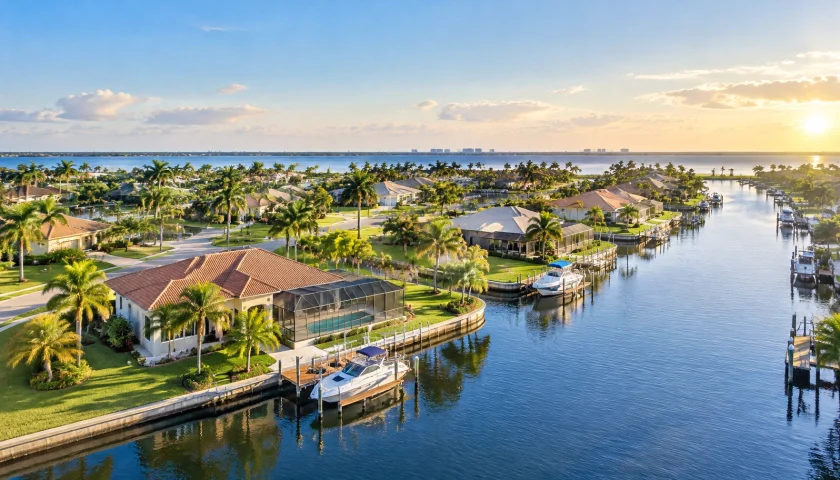
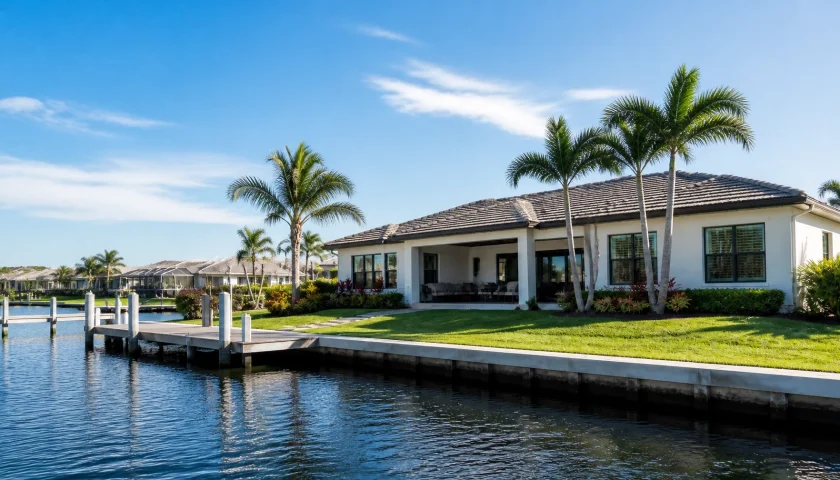
For buyers, that can mean more time to compare homes, inspect properties, evaluate insurance, and understand tax implications. For sellers, pricing and presentation remain important because buyers are comparing multiple options. This is especially true for SWFL waterfront homes, where seawalls, docks, flood zones, insurance, and maintenance can materially affect value.
The current market also reinforces why a personalized cape coral market update 2026 should include more than median price. A home’s flood zone, age, roof, insurance history, assessment, tax status, and waterfront improvements may all affect the right offer or listing strategy.
Insurance and flood-map considerations
Last week’s insurance update remains relevant, but it does not need to overshadow today’s tax discussion. Citizens’ 2026 homeowners multiperil rates decreased by an average of 8.8%, while wind-only rates decreased by 5.5%, effective July 1, 2026. Even so, the average Lee County homeowners premium remains roughly $3,576 per year, and flood insurance is separate, with the Lee County NFIP median near $1,757 per year.
There is also a FEMA map change to watch. Revisions affecting six panels in unincorporated Lee County near the Mullock Creek floodway are scheduled to take effect on March 2, 2027. The affected panels are:
- 12071C0576
- 12071C0577
- 12071C0578
- 12071C0579
- 12071C0581
- 12071C0583
Properties newly mapped into a Special Flood Hazard Area may face mandatory flood insurance requirements when financed with a federally backed mortgage. Flood-zone changes can also affect permitting, repairs, renovations, elevation requirements, and future resale considerations.
Property owners and buyers should check the Lee County flood information page and the FEMA Map Service Center. Ask the insurance agent, lender, surveyor, and local floodplain administrator to review the property’s current and future status. A general online map view should not replace property-specific verification.

Final-quarter checklist for buyers and relocating homeowners
Before making an offer or planning a late-2026 move:
- Confirm whether the home will qualify as your Florida homestead.
- Review the Amendment 3 residency timing rules with the Lee County Property Appraiser.
- Ask how Save Our Homes portability may apply to your current Florida homestead.
- Obtain an insurance quote for homeowners, wind, and flood coverage before the inspection period ends.
- Check the property’s FEMA flood zone and whether it is near an affected map panel.
- Review the roof age, seawall, dock, elevation certificate, permits, and prior storm repairs.
- Budget for taxes, insurance, utilities, maintenance, HOA fees, and financing, not just the purchase price.
- If moving from out of state, document the date you establish Florida residency.
- Have your real estate agent and closing professional coordinate the timing of the purchase and homestead filing.
Final-quarter checklist for sellers and snowbirds
For homeowners preparing to sell before or during snowbird season:
- Price against current comparable sales, not only last year’s high-water marks.
- Gather recent tax bills, insurance declarations, flood information, permits, and improvement records.
- Explain any homestead or portability considerations to your listing agent.
- Prepare for buyer questions about insurance premiums and flood zones.
- Highlight practical features such as newer roofs, storm protection, generators, seawalls, docks, and elevation improvements.
- Plan showing access carefully if you are a seasonal resident.
- If you are selling and buying another Florida home, discuss the timing of portability applications.
- Consider whether a pre-listing inspection would reduce surprises during negotiations.
RE/MAX Realty Team helps buyers, sellers, investors, retirees, and second-home owners evaluate the full picture. With more than 100 agents and two offices, the brokerage serves Cape Coral, Fort Myers, Sanibel, Fort Myers Beach, Estero, Bonita Springs, and surrounding Lee County communities. The company has been the #1 producing brokerage in the region for more than 14 years, with local resources for everything from primary residences to waterfront and investment properties.
Explore homes for sale in Southwest Florida, learn more about selling your home, or contact RE/MAX Realty Team to discuss your goals.
Frequently asked questions
Does Amendment 3 eliminate all Florida property taxes on a homesteaded home?
No. It would increase the homestead exemption for non-school taxes only. School taxes and any taxable value remaining after the exemption would still apply.
Would a new Florida resident in 2027 receive the full increased exemption immediately?
Generally, no. Under the proposed rules, someone who was not a Florida resident by December 31, 2026, would generally receive the existing homestead exemption first. The increased exemption would generally begin in the fifth year of homestead eligibility, subject to the amendment’s language and applicable rules.
Can I transfer my Save Our Homes benefit when moving from Cape Coral to Fort Myers?
Florida portability rules may allow an eligible homeowner to transfer accumulated Save Our Homes savings to a new Florida homestead. Amendment 3 would expand portability under its proposed framework. Because deadlines and eligibility matter, confirm the details with the property appraiser before listing or purchasing.
Will the Amendment 3 savings cover homeowners insurance or flood insurance?
No. The exemption concerns property taxes. Homeowners insurance, wind coverage, flood insurance, deductibles, and other ownership costs remain separate.
Do the March 2027 FEMA map changes affect every Lee County property?
No. The revision applies to six flood-map panels in unincorporated Lee County near the Mullock Creek floodway. Owners should check the specific parcel through Lee County and the FEMA Map Service Center.
The takeaway for Lee County homeowners and movers
Amendment 3 could create meaningful non-school property tax savings for qualifying homesteads, especially once the proposed exemption reaches $250,000 in 2028. It may also make portability more relevant for existing Florida homeowners deciding whether to move within Cape Coral, Fort Myers, or another Lee County community.
For out-of-state buyers, the most important planning detail is the December 31, 2026 residency cutoff. Buyers considering a year-end relocation should verify the relationship between closing, Florida residency, homestead eligibility, and the five-year rule before making assumptions.
At the same time, buyers and sellers should keep the larger ownership picture in view: current market conditions, insurance, flood exposure, property condition, and resale potential. In Southwest Florida real estate, the best decision is usually the one that accounts for both today’s purchase and the ongoing cost of owning the home.